
7 Reasons to train with Altitude Hypoxia
Altitude (hypoxic) training—whether done in real mountains or simulated by a machine—works by exposing your body to lower oxygen availability than at sea level. Altitude at 2200–4000 m is enough to trigger meaningful physiological adaptations without being extreme for most people.
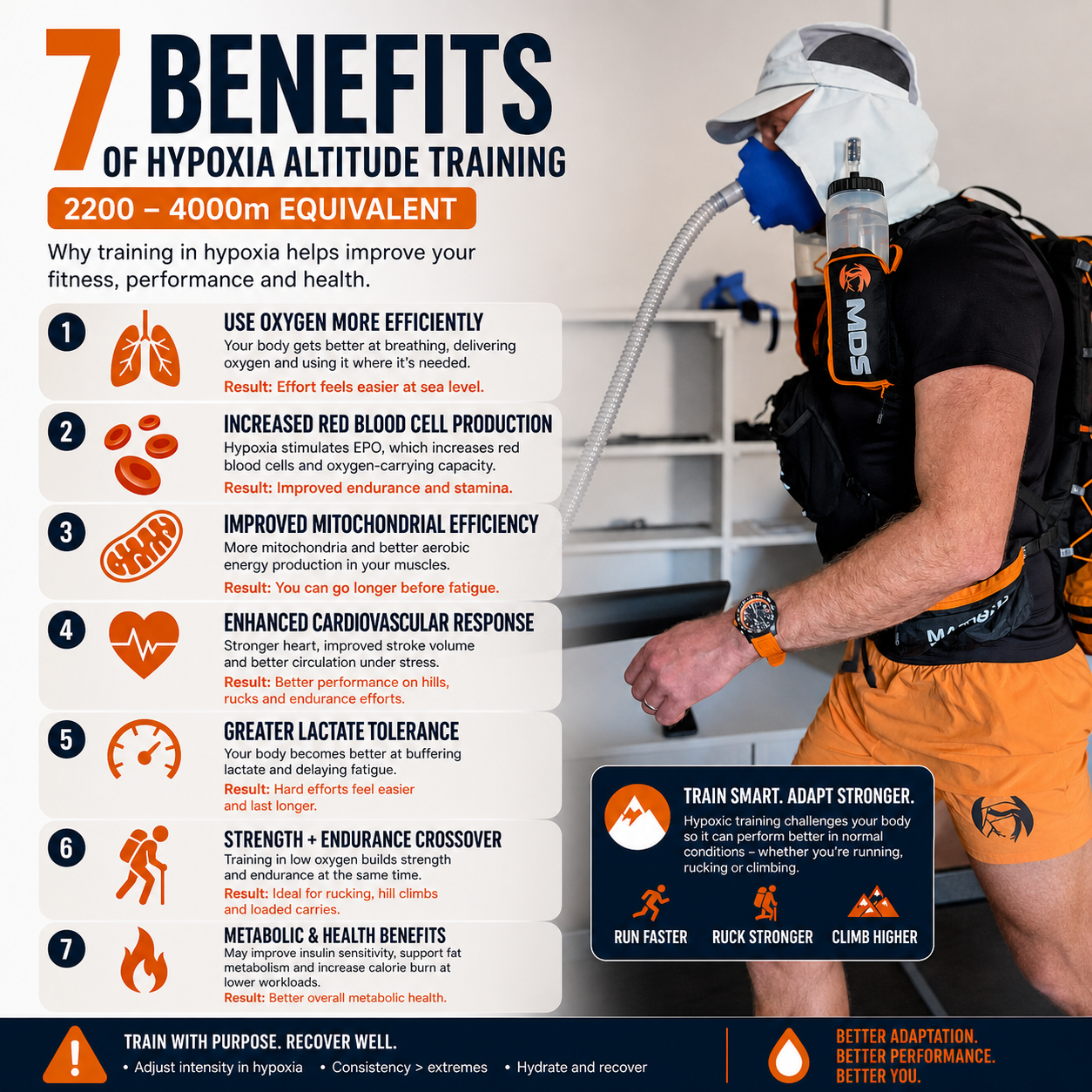
Here’s what’s going on and why it can improve fitness for things like running, rucking, or uphill walking:
1. Your body learns to use oxygen more efficiently
At altitude, there’s less oxygen in each breath. Your body responds by:
Increasing breathing rate
Improving oxygen extraction in muscles
Becoming more efficient at delivering oxygen where it’s needed
Result: When you return to normal oxygen levels, the same effort feels easier.
2. Increased red blood cell production (EPO effect)
Hypoxia stimulates the release of erythropoietin (EPO), which tells your body to produce more red blood cells.
More red blood cells = more oxygen-carrying capacity
This is one of the main endurance benefits
Why it matters: Better oxygen transport directly improves endurance performance (running, hiking, loaded carries).
3. Improved mitochondrial efficiency
Your muscles adapt by:
Increasing mitochondrial density (your “energy factories”)
Becoming better at aerobic energy production
Result: You can sustain effort longer before fatigue sets in.
4. Enhanced cardiovascular response
Training in hypoxia can:
Increase heart efficiency
Improve stroke volume (how much blood your heart pumps per beat)
Train your system to handle higher stress at lower oxygen
This is especially helpful for:
Uphill walking
Rucking (which is very oxygen-demanding)
Sustained aerobic work
5. Greater lactate tolerance
Hypoxic training pushes your body closer to its limits faster, which:
Improves your ability to buffer lactate
Delays the “burn” and fatigue
Practical effect: You can go harder for longer before needing to slow down.
6. Strength + endurance crossover (great for rucking)
Because oxygen is limited:
Even moderate loads feel harder
Your muscles adapt to produce force under fatigue
This is particularly relevant for:
Weighted walking (rucking)
Hill climbing
Military-style endurance work
7. Metabolic and general health benefits
There’s some evidence hypoxia exposure may:
Improve insulin sensitivity
Support fat metabolism
Increase calorie burn at lower workloads
Though these effects are secondary compared to endurance gains.
Important caveats (this is where people get it wrong)
Intensity must be adjusted: You cannot train as hard in hypoxia—overdoing it leads to burnout, not gains.
More is not always better: 4000 m equivalent is quite aggressive; many benefits occur already at ~2000–2500 m.
Consistency matters more than extremes: Regular exposure beats occasional very hard sessions.
Hydration and recovery are critical: Hypoxia increases stress on the body.
Why it helps specifically for you
Running: Improves VO₂ max and endurance efficiency
Rucking with weight: Enhances oxygen delivery under load + fatigue resistance
Walking uphill: Trains your aerobic system in a more demanding way than normal terrain
Bottom line
Hypoxic training works because it forces your body to adapt to less oxygen, making it more efficient at using and delivering oxygen when you return to normal conditions. That translates into better endurance, resilience, and performance across a wide range of activities.