
Executive Recovery: The Missing Link Between High Performance and Long-Term Wellbeing
In today's fast-paced business environment, success often comes with relentless pressure. Business owners, directors, executives and high-performing professionals are expected to make critical decisions, lead teams, manage uncertainty and deliver results consistently. While ambition and dedication drive success, many professionals neglect one of the most important components of sustainable performance: recovery.
Executive recovery is not a luxury. It is a strategic investment in health, wellbeing and long-term effectiveness.
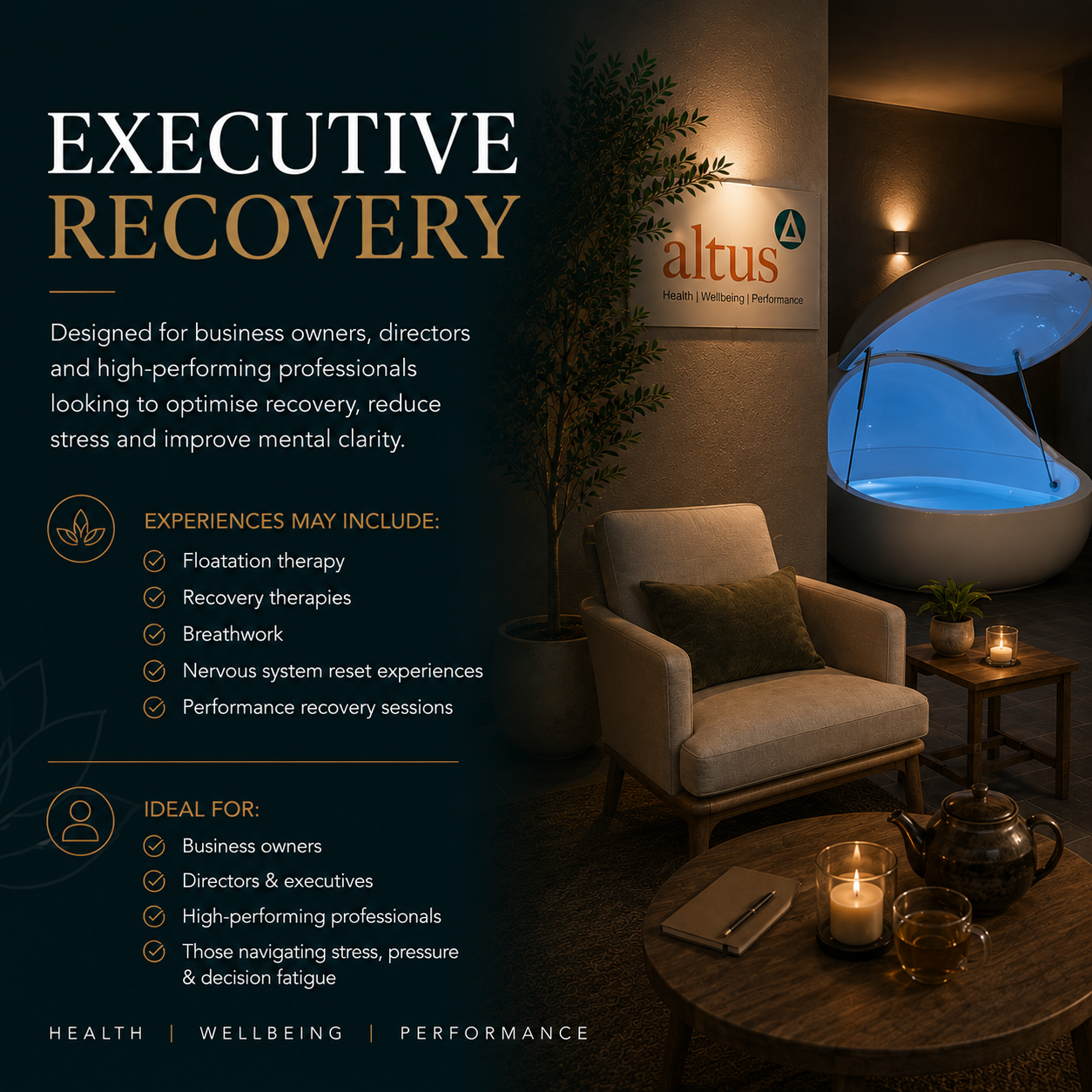
In today's fast-paced business environment, success often comes with relentless pressure. Business owners, directors, executives and high-performing professionals are expected to make critical decisions, lead teams, manage uncertainty and deliver results consistently. While ambition and dedication drive success, many professionals neglect one of the most important components of sustainable performance: recovery.
Executive recovery is not a luxury. It is a strategic investment in health, wellbeing and long-term effectiveness.
The Hidden Cost of Constant Performance
Many professionals operate in a state of continuous demand. Long hours, back-to-back meetings, constant connectivity and increasing responsibilities can create a cycle where stress becomes normalised.
Initially, this may seem manageable. However, prolonged exposure to stress without adequate recovery can lead to:
Mental fatigue
Reduced concentration and focus
Poor decision-making
Increased anxiety and stress
Sleep disruption
Reduced resilience
Physical exhaustion
Decreased motivation and productivity
Emotional burnout
The body and mind are not designed to operate at maximum capacity indefinitely. Just as athletes prioritise recovery between training sessions, executives must create opportunities for restoration to maintain peak performance.
Understanding Burnout
Burnout is more than simply feeling tired after a busy week. It is a state of physical, emotional and mental exhaustion caused by prolonged and unmanaged stress.
Common signs of burnout include:
Persistent fatigue
Difficulty concentrating
Increased irritability
Lack of motivation
Feeling overwhelmed
Reduced job satisfaction
Sleep disturbances
Frequent illness
When burnout takes hold, performance inevitably suffers. Relationships can become strained, health can deteriorate and professional effectiveness declines.
The challenge is that burnout often develops gradually, making it difficult to recognise until significant damage has already occurred.
Why Executive Recovery Matters
Executive recovery focuses on actively restoring physical, mental and emotional resources before burnout occurs.
Rather than waiting until exhaustion becomes unavoidable, recovery provides a proactive approach to maintaining health and wellbeing.
Improved Mental Clarity
High-quality decisions require a clear and focused mind. Chronic stress can impair cognitive function, reduce creativity and increase mental fog.
Recovery practices help calm the nervous system, allowing the brain to process information more effectively and improve strategic thinking.
Better Stress Management
Stress itself is not the problem. In fact, moderate levels of stress can enhance performance. The issue arises when there is no opportunity for recovery.
Executive recovery helps regulate stress levels, allowing professionals to remain resilient and adaptable when facing challenges.
Enhanced Physical Health
Prolonged stress can contribute to elevated blood pressure, weakened immunity, poor sleep and increased risk of chronic health conditions.
Regular recovery supports overall physical wellbeing and helps maintain energy levels required for sustained performance.
Increased Productivity
Contrary to popular belief, working longer hours does not always lead to better results.
Professionals who prioritise recovery often experience:
Greater focus
Improved efficiency
Better time management
Enhanced problem-solving abilities
Increased creativity
Recovery allows individuals to work smarter rather than simply working harder.
Sustainable High Performance
Elite athletes understand that recovery is where adaptation and improvement occur. The same principle applies to business performance.
Recovery enables professionals to maintain high standards over the long term rather than experiencing cycles of intense productivity followed by exhaustion.
The Role of Nervous System Recovery
Many executives spend the majority of their time in a heightened state of alertness, often referred to as "fight or flight" mode.
While useful during short periods of challenge, remaining in this state continuously can have significant consequences for health and wellbeing.
Executive recovery experiences such as:
Floatation therapy
Breathwork
Guided relaxation
Recovery therapies
Mindfulness practices
can help activate the body's parasympathetic nervous system, often known as the "rest and recover" state.
This shift allows the body to repair, restore and rebalance itself more effectively.
Recovery Is a Performance Strategy
The most effective leaders understand that wellbeing and performance are not separate goals. They are interconnected.
Recovery should be viewed as a key component of professional success, alongside leadership development, strategic planning and business growth.
Investing in recovery helps individuals:
Lead more effectively
Think more clearly
Perform more consistently
Protect their long-term health
Reduce the risk of burnout
Final Thoughts
Success should not come at the expense of your health.
Executive recovery provides a proactive and sustainable approach to maintaining wellbeing while supporting high performance. By prioritising recovery, professionals can reduce stress, improve resilience, enhance mental clarity and continue performing at their best without reaching the point of burnout.
The most successful leaders are not those who push themselves endlessly. They are the ones who understand when to pause, recover and return stronger.
Because sustainable performance starts with recovery.
If you would like to know more drop an email to hello@thealtuslife.co.uk with subject ‘Executive Recovery’