
Incline walking, weighted rucking & altitude training
Discover how treadmill gradient, walking speed, carried weight and simulated altitude change your training experience. Explore the comparisons and estimate your own energy expenditure.
Small changes. A more demanding walk
Walking uphill increases the work required to move your body. Adding a vest or rucksack increases the load. Simulated altitude may make the same session feel harder, although it does not have a reliable fixed energy expenditure multiplier.
01 · Incline walking
Compare NordicTrack-style 12% and 15% incline settings at 3, 4 or 5 mph. These settings are percentage gradients, not angles in degrees.
02 · Weighted rucking
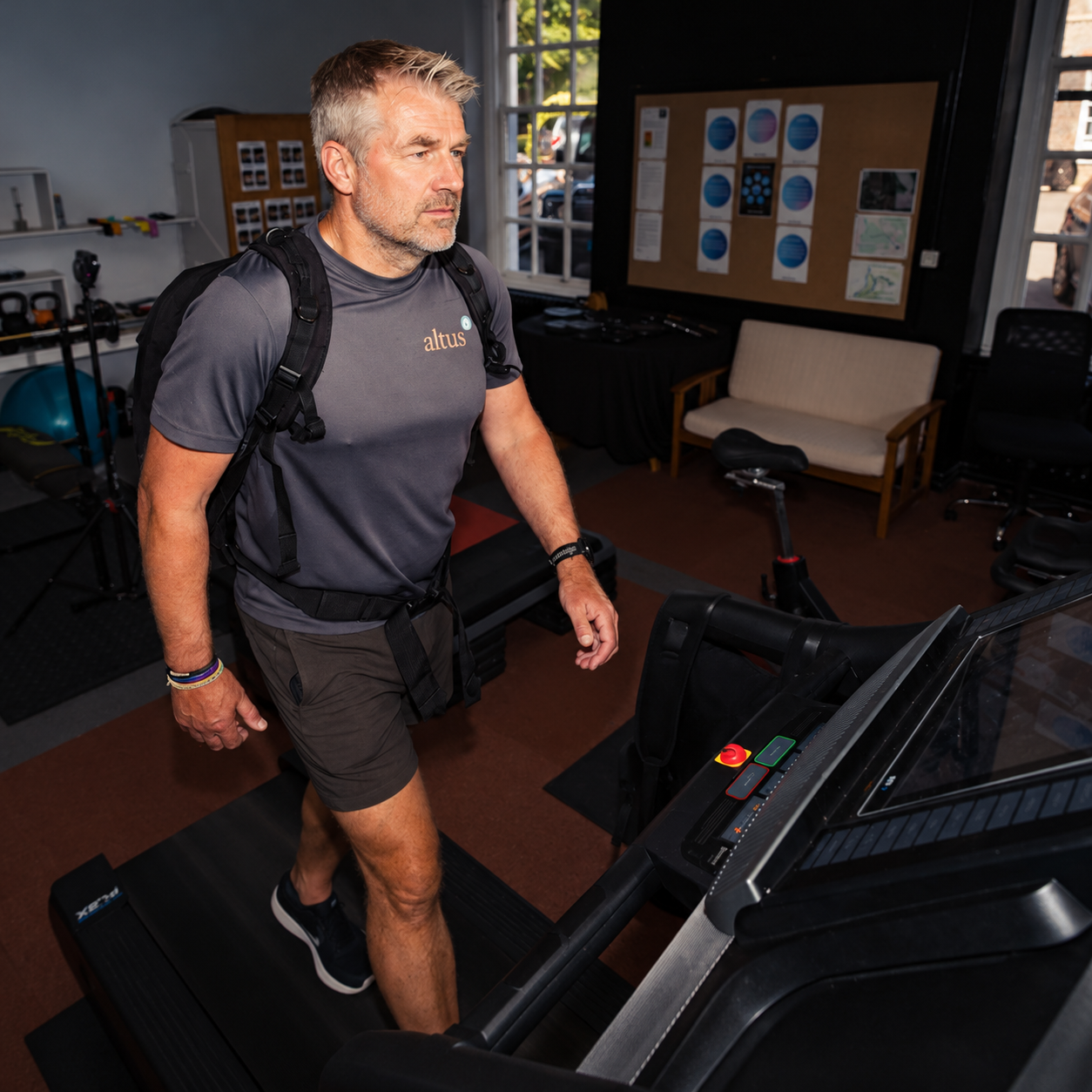
See the estimated effect of carrying 5, 10 or 15 kg. Build gradually and keep the load secure rather than relying on treadmill handrails.
03 · Simulated altitude
Explore training selections at 2,000 m, 2,250 m and 2,500 m. Hypoxia can increase physiological strain even when estimated mechanical work is unchanged.
Calculate your treadmill energy expenditure
Adjust the settings to see estimated total energy expenditure and how the extra load changes the result. The graphs below update with your selections.
Sea level selected. No altitude energy expenditure adjustment is applied.
These figures estimate total energy expenditure, including resting energy use during the session, rather than exercise-only ‘active’ energy expenditure.
Altitude note: Selecting 2,000-2,500m changes the training context, not the estimate. Simulated hypoxia may increase perceived effort, heart rate and breathing demand.
See what changes your energy expenditure estimate
These charts use your selected body weight and duration. The speed comparison uses no additional load; the weighted comparison uses your selected speed and incline.
12% versus 15% incline
Estimated expenditure by speed · no additional load
Effect of carrying weight
Estimated energy expenditure at selected speed and incline
Charts and calculations use the ACSM walking metabolic equation with added load modelled as additional mass. At 4–5 mph, especially at steep gradients, the formula is extrapolated beyond its usual walking-speed range and can be substantially less reliable. Individual results vary.
More than a number
Training with reduced oxygen availability can be a separate endurance challenge. The three simulated-altitude options are useful for describing session conditions, but should not be interpreted as proven extra energy expenditure.
2,000 m
A moderate simulated-altitude selection. Begin with manageable exercise intensity and monitor how you respond.
2,250 m
A step up in simulated altitude. Adjust speed, incline or duration to match your individual tolerance.
2,500 m
A more demanding simulated-altitude selection for some participants. Supervision and suitable screening are important.
Simulated hypoxia is not identical to living or exercising at actual altitude. Consult a qualified clinician before hypoxic exercise if you have cardiovascular, respiratory, sleep-related breathing or oxygen-saturation concerns. Stop if you experience dizziness, chest discomfort or unusual breathlessness.
Build gradually, rather than chasing a number
Start with a steady walk
Choose a pace and incline you can sustain comfortably without gripping the handrails. At 12–15%, even 3 mph can be challenging.
Add load progressively
Try a light, well-fitted 5 kg load before progressing. Reduce incline or speed if your gait changes or your calves and joints become uncomfortable.
Keep altitude separate
When using simulated altitude, reduce other training demands as needed. Greater breathing effort does not automatically mean more calories burned.